
When someone texts you “NVM,” they usually mean “never mind.” It is a common abbreviation in texting and online conversations that tells someone to forget a question, ignore a previous message, or stop worrying about something.
However, the exact meaning can depend on the conversation and the sender’s tone.
For example, if a friend asks you for help and then figures something out alone, they might send “nvm” to let you know they no longer need assistance.
In other situations, the same abbreviation might sound impatient, disappointed, playful, or slightly annoyed.
Understanding what does NVM mean in text can help you interpret messages on WhatsApp, Snapchat, Instagram, TikTok, Discord, and other platforms.
Although it is usually harmless and casual, context matters. Below, you will learn what NVM stands for, how people use it, how to respond naturally, and how to tell what someone really means when they send it.
Quick Answer: What Does NVM Mean?
NVM means “never mind” in text messages. People use it when they want someone to ignore an earlier message, when a question is no longer important, or when they have solved a problem themselves. It is informal, common in digital conversations, and usually harmless, although the tone can sometimes suggest frustration or disappointment.
What Does NVM Mean in Text?
NVM is short for never mind, an expression used to tell someone not to worry about something or to disregard what was said earlier.
People commonly send it after asking a question, requesting help, or starting a conversation they no longer want to continue. It saves time and keeps messages short.
Pronunciation: NVM is generally understood as the letters “N-V-M” when spoken aloud. Some people simply say “never mind” instead.
Examples of NVM in Texting
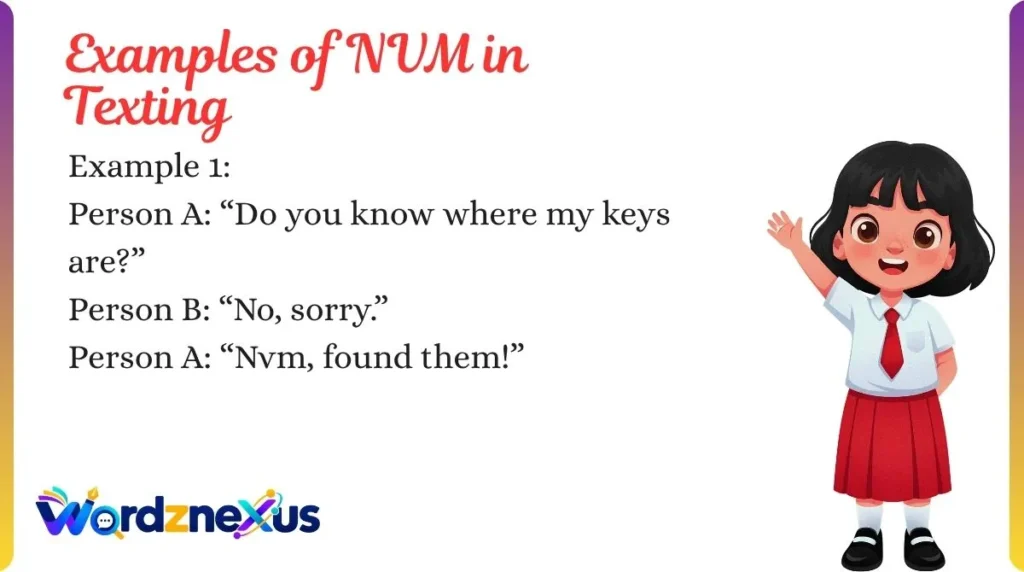
Example 1:
Person A: “Do you know where my keys are?”
Person B: “No, sorry.”
Person A: “Nvm, found them!”
Here, NVM means the person no longer needs help because they found the keys.
Example 2:
Person A: “Can I ask you something?”
Person B: “Sure, what is it?”
Person A: “Nvm, it’s not important.”
In this example, the sender has decided not to ask the question. Depending on the relationship and conversation, the other person might wonder why they changed their mind.
Does NVM Always Mean the Same Thing?
The basic meaning remains “never mind,” but the emotional tone can change.
- Casual: The sender has figured something out.
- Friendly: The sender wants to save you time.
- Embarrassed: The sender has changed their mind about asking something.
- Annoyed: The sender may be frustrated that you did not respond quickly.
- Playful: The sender may be joking or teasing.
The words before and after NVM, along with punctuation, emojis, and previous messages, usually provide the best clues.
Origin and Background of NVM
NVM developed as a shortened form of the established English expression “never mind.” The phrase itself existed long before modern texting and has traditionally been used to tell someone not to worry, disregard something, or stop giving attention to a matter.
As text messaging and online chat became common, people increasingly used abbreviations to communicate quickly. NVM became a convenient way to express the same idea using just three letters.
Today, the abbreviation appears in private messages, online discussions, gaming chats, social media comments, and everyday digital conversations. Both lowercase “nvm” and uppercase “NVM” are widely understandable.
There is no need to assume that the abbreviation has a separate or secret meaning whenever someone uses it. In ordinary texting, “never mind” is the standard interpretation.
How NVM Is Used in Text Conversations
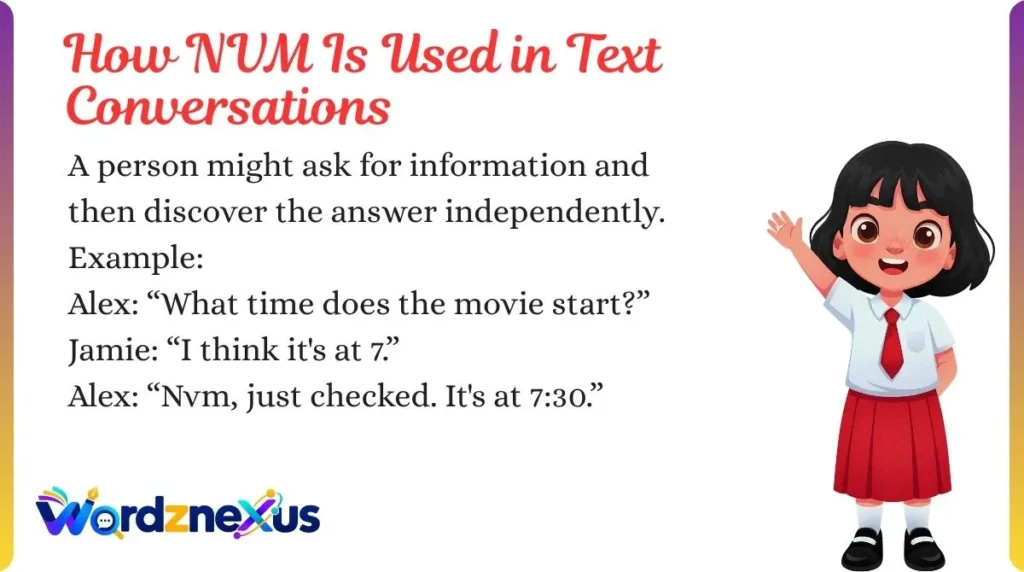
People use NVM in several situations. The meaning is usually straightforward, but the surrounding conversation helps reveal the sender’s intention.
1. When Someone Finds an Answer
A person might ask for information and then discover the answer independently.
Example:
Alex: “What time does the movie start?”
Jamie: “I think it’s at 7.”
Alex: “Nvm, just checked. It’s at 7:30.”
Here, NVM simply means the original question no longer needs an answer.
2. When Someone No Longer Needs Help
NVM is often used to cancel a request.
Example:
Sam: “Can you help me fix this setting?”
Taylor: “Yeah, send me a screenshot.”
Sam: “Nvm, I fixed it!”
This is a neutral, practical use. It does not imply that Sam is upset with Taylor.
3. When Someone Changes Their Mind
Sometimes, a sender begins asking something but decides against it.
Example:
Mia: “Can I tell you something?”
Noah: “Of course.”
Mia: “Nvm, maybe later.”
This could indicate hesitation, embarrassment, or a desire for privacy. It does not automatically mean something is wrong.
4. When Someone Feels Annoyed
NVM can sound dismissive if the sender feels ignored or misunderstood.
Example:
Person A: “Can you call me when you’re free?”
Person B: “I’ll be busy for a while.”
Person A: “Nvm, forget it.”
The phrase may communicate disappointment, especially if the sender expected support. Still, one message is not enough to determine someone’s emotional state with certainty.
5. When Friends Are Joking
Friends may use NVM to create a playful change of direction.
Example:
Chris: “Guess who I saw today?”
Jordan: “Who?”
Chris: “Nvm, you’ll never guess 😂”
In this situation, the abbreviation is part of a joke rather than a serious request to end the conversation.
What Does NVM Mean on Different Platforms?
NVM generally means “never mind” across social media, messaging apps, and online communities. The platform does not usually change its core meaning.
NVM on WhatsApp
On WhatsApp, NVM commonly appears in private chats and group conversations. Someone might use it to cancel a question, withdraw a request, or explain that they have solved a problem.
Example: “Nvm, I got the address from Sarah.”
NVM on Snapchat
On Snapchat, NVM may appear in quick messages between friends or people getting to know each other. It can indicate a changed mind or a question the sender no longer wants to ask.
Example: “Wait, can I ask you something? Nvm lol.”
The meaning depends on the conversation, not simply on the fact that it was sent through Snapchat.
NVM on Instagram
Instagram users may use NVM in direct messages, comments, or conversations about posts and stories.
Example: “Which picture did you mean? Nvm, I found it.”
NVM on TikTok
On TikTok, NVM can appear in comments, direct messages, and discussions about videos.
Example: “Can you send me that creator’s username? Nvm, found the account.”
It retains its usual meaning rather than having a special TikTok definition.
NVM on Facebook
Facebook users may use NVM in Messenger conversations, groups, and comments.
Example: “Are we meeting today? Nvm, I saw your update.”
NVM on Discord
On Discord, NVM is common in casual chat, gaming conversations, and community discussions.
Example: “Anyone know how to fix this error? Nvm, restarting worked.”
It may be followed by a quick explanation of what the sender discovered.
NVM on Dating Apps
On dating apps, NVM can appear when someone changes their mind about a question, message, or invitation.
Example:
Person A: “Would you want to meet this weekend?”
Person B: “Maybe. Let me check my schedule.”
Person A: “Nvm, we can figure it out later.”
Depending on the conversation, the last message could sound considerate or disappointed. Avoid assuming that NVM indicates romantic interest, rejection, or anger without additional context.
What Does NVM Mean From a Girl or Guy?
NVM means “never mind” regardless of whether a girl or a guy sends it. Gender does not give the abbreviation a different standard definition.
However, the reason for using it can vary from person to person.
When a Girl Sends NVM
A girl might send NVM because she has found an answer, changed her mind, feels embarrassed about a question, or no longer needs help.
Example:
Her: “Can I ask you something?”
You: “Sure.”
Her: “Nvm, I’ll ask you tomorrow.”
This could mean she is tired, uncertain, busy, or simply postponing the conversation. It is not automatically a sign that she is upset or losing interest.
When a Guy Sends NVM
A guy might use NVM to cancel a request, avoid explaining something further, or indicate that a problem has been resolved.
Example:
Him: “Do you have the notes from class?”
You: “I’ll check.”
Him: “Nvm, my friend just sent them.”
This is a straightforward example with no obvious emotional meaning.
How to Understand the Real Meaning
Consider these clues before interpreting the message:
- Conversation history: Was the person asking for help, sharing feelings, or making plans?
- Response timing: Were they waiting for an answer? A delayed reply alone does not prove frustration.
- Punctuation: “Nvm.” may feel more abrupt than “nvm lol,” but neither guarantees a particular emotion.
- Emojis: A laughing emoji may suggest humor, while a sad face may communicate disappointment.
- Relationship: A close friend, partner, coworker, or new acquaintance may use the abbreviation differently.
If you are unsure, a simple question such as “Are you okay, or did you figure it out?” can clear up confusion without creating unnecessary tension.
Other Possible Meanings of NVM
Although “never mind” is the most common meaning in everyday texting, NVM can have other meanings in specific technical or professional contexts.
| Meaning | Context | Example |
|---|---|---|
| Never mind | Everyday texting and online chat | “Nvm, I found it.” |
| Non-Volatile Memory | Computing and electronics | “The device stores settings in NVM.” |
| Node Version Manager (NVM) | Some software-development discussions, referring to a tool for managing Node.js versions | “Install NVM to switch between Node.js versions.” |
The technical meanings are context-dependent. In software development, NVM often refers specifically to Node Version Manager, while non-volatile memory is another established technical use of the same abbreviation.
If you receive NVM in a casual conversation, interpret it as “never mind” unless the surrounding discussion clearly concerns computing, programming, or electronics.
How to Respond to NVM
The best response depends on whether the sender appears relaxed, playful, confused, or upset. You do not always need to respond; sometimes the conversation has simply reached its natural end.
Here are seven natural replies for different situations.
1. Casual Reply
Use this when the sender has found an answer or no longer needs help.
Example:
Friend: “Nvm, I found it.”
You: “Okay, no worries!”
2. Friendly Reply
Use this when you want to show that you are available to help.
Example:
Friend: “Nvm, I figured it out.”
You: “All good! Let me know if you need anything else.”
3. Funny Reply
Use this when you share a playful relationship.
Example:
Friend: “Nvm 😂”
You: “Now I’m curious. What was it? 😂”
This works best when joking around is normal between you.
4. Caring Reply
Use this when the sender seems disappointed or hesitant.
Example:
Friend: “Nvm, forget it.”
You: “It’s okay. If you still want to talk, I’m here.”
This gives them space without pressuring them.
5. Clarifying Reply
Use this when you are unsure whether they still need something.
Example:
Person: “Nvm.”
You: “Did you figure it out, or do you still need help?”
6. Romantic Reply
Use this when your partner or someone you are dating seems reluctant to share something.
Example:
Partner: “Nvm, it’s nothing.”
You: “Okay, but you can tell me if something’s bothering you.”
This communicates care without assuming that they are hiding something serious.
7. Reply to a Potentially Annoyed Message
If the sender seems frustrated, stay calm rather than responding defensively.
Example:
Friend: “Nvm. I’ll do it myself.”
You: “Sorry if I took too long to reply. Do you still want my help?”
A calm response can prevent a minor misunderstanding from becoming an argument.
Similar Texting Terms and Their Differences
Several abbreviations and expressions have meanings related to NVM, but they are not interchangeable in every situation.
| Term | Meaning | Key Difference |
|---|---|---|
| NM | Never mind; sometimes “not much,” depending on context | More ambiguous than NVM |
| IDK | I don’t know | Expresses uncertainty rather than withdrawing a question |
| BTW | By the way | Introduces additional information |
| JK | Just kidding | Clarifies that something was a joke |
| Forget it | Disregard something or stop pursuing it | Usually written in full and may sound more direct or frustrated |
NVM vs. NM
NVM usually means “never mind.” NM can mean the same thing, but in response to “What’s up?” it often means “not much.”
Example:
Person A: “How are you?”
Person B: “NM, just relaxing.”
Here, NM means “not much,” not “never mind.”
NVM vs. IDK
IDK means “I don’t know,” while NVM means “never mind.”
Example:
“I don’t know where it is” expresses a lack of information. “Nvm, I found it” tells someone that the original question no longer needs an answer.
NVM vs. Forget It
Both expressions can tell someone to disregard something. However, “forget it” can sound more forceful or emotionally charged in certain conversations. NVM is often used casually and without any negative intention.
Common Misunderstandings About NVM
Even though NVM is simple, it can be misunderstood when people read too much into a short message.
1. Assuming the Sender Is Angry
A message such as “nvm” does not automatically mean someone is annoyed. They may have solved their problem or decided that the question was unnecessary.
Look at the previous messages before drawing conclusions.
2. Thinking NVM Means Rejection
If someone sends NVM after asking a personal question, it might mean they feel uncomfortable or have changed their mind. It does not necessarily indicate rejection, romantic disinterest, or a problem in the relationship.
3. Confusing NVM With NM
NM can mean “not much” or “never mind.” The surrounding sentence usually clarifies which meaning is intended.
4. Treating Capitalization as a Secret Signal
“NVM,” “nvm,” and “Nvm” generally have the same meaning. Uppercase letters may reflect typing habits or emphasis, but capitalization alone cannot reliably reveal anger or urgency.
5. Misreading Punctuation
“Nvm.” may look abrupt, while “nvm 😂” appears more playful. These are useful clues, not dependable rules. Different people use punctuation and emojis differently.
6. Assuming NVM Always Ends a Conversation
Sometimes NVM closes one topic, but the sender may continue chatting about something else. For example, “Nvm, I found the answer. Anyway, how was your day?” clearly keeps the conversation going.
Is NVM Appropriate or Safe to Use?
NVM is generally informal, harmless, and appropriate for everyday texting. It is commonly understood among people who use abbreviations in digital conversations.
When NVM Is Appropriate
You can use it when:
- You have solved a problem yourself.
- You no longer need an answer.
- You want to cancel a casual request.
- You are chatting with friends or family.
- You are participating in an informal online discussion.
For example, “Nvm, I found the link” is a natural way to update someone.
When to Avoid NVM
In formal emails, professional reports, or important workplace discussions, spelling out “never mind” or explaining the situation more clearly is usually better.
Instead of writing:
“NVM, don’t worry about it.”
You could write:
“Never mind, I found the information I needed. Thank you for your help.”
This sounds clearer and more professional.
Can NVM Sound Rude?
Yes, in some situations. A message such as “Nvm, forget it” can sound dismissive if the sender is frustrated or feels ignored. However, the abbreviation itself is not inherently rude or offensive.
If you are concerned about someone’s tone, consider the wider conversation and ask for clarification rather than assuming the worst.
12 Examples of NVM in Text Messages
These examples show how NVM works in different everyday situations.
Example 1: Finding Something
Alex: “Have you seen my charger?”
Taylor: “Nope.”
Alex: “Nvm, it’s under my desk.”
Meaning: Alex found the charger and no longer needs help.
Example 2: Asking for Directions
Mia: “Which street do I turn onto?”
Noah: “Give me a second.”
Mia: “Nvm, the GPS showed me.”
Meaning: Mia found the directions independently.
Example 3: Canceling a Request
Chris: “Can you send me the homework answers?”
Jordan: “I’ll look for them.”
Chris: “Nvm, I found the worksheet.”
Meaning: Chris no longer needs the requested information.
Example 4: Changing Plans
Sam: “Are you free to call tonight?”
Jamie: “Probably after eight.”
Sam: “Nvm, we can talk tomorrow.”
Meaning: Sam has decided to postpone the call.
Example 5: Feeling Embarrassed
Lily: “Can I ask you something personal?”
Emma: “Of course.”
Lily: “Nvm, maybe another time.”
Meaning: Lily has changed her mind or is not ready to ask.
Example 6: Friendly Humor
Ben: “Guess what happened at school?”
Max: “What?”
Ben: “Nvm, the story is too long 😂”
Meaning: Ben is joking about the story rather than necessarily ending the conversation.
Example 7: Mild Frustration
Ava: “Can you help me with this?”
Ryan: “I’m busy right now.”
Ava: “Nvm, I’ll figure it out.”
Meaning: Ava may be disappointed, but the context does not prove that she is angry.
Example 8: Gaming Chat
Player 1: “Where did the team go?”
Player 2: “They’re near the bridge.”
Player 1: “Nvm, I see them.”
Meaning: The player has found the team.
Example 9: Social Media
Maya: “What’s the name of that song in your story?”
Sophie: “I’ll check.”
Maya: “Nvm, Shazam found it!”
Meaning: Maya identified the song herself.
Example 10: Romantic Conversation
Partner A: “Do you want to talk about what happened?”
Partner B: “Nvm, I’m just tired. Can we talk tomorrow?”
Meaning: The sender wants to postpone the discussion. It does not automatically mean they are upset with their partner.
Example 11: Workplace Chat
Coworker A: “Do you have the latest file?”
Coworker B: “Checking now.”
Coworker A: “Nvm, I found it in the shared folder.”
Meaning: The original request is no longer necessary. In a formal workplace, a complete sentence may be preferable.
Example 12: Clarifying a Question
Jordan: “What was the name of that restaurant?”
Taylor: “Which one?”
Jordan: “Nvm, my brother just reminded me.”
Meaning: Jordan has remembered the name and no longer needs an answer.
Frequently Asked Questions
What does NVM stand for in texting?
NVM stands for “never mind.” It is an abbreviation used when someone wants to withdraw a question, cancel a request, or tell another person that something no longer needs attention. For example, “Nvm, I found the address” means the sender has already found the information they wanted.
Does NVM mean never mind or not very much?
In everyday texting, NVM usually means “never mind.” It is different from NM, which can mean “not much” in response to questions such as “What’s up?” The correct interpretation depends on the letters used and the surrounding conversation, particularly when someone is using short, informal replies.
What does NVM mean from a girl in a text?
When a girl sends NVM, she generally means “never mind,” just as anyone else would. She might have found an answer, changed her mind, or decided not to ask something. Her message alone does not prove she is angry, upset, shy, or romantically interested. Consider the context before interpreting her intention.
Is NVM rude or passive-aggressive?
NVM is not inherently rude. It can be a neutral way to say that a question no longer matters. However, “nvm, forget it” may sound frustrated if it follows an argument or a delayed response. The relationship, conversation history, and sender’s usual communication style help determine the likely tone.
What is the difference between NVM and NM?
NVM normally means “never mind.” NM can mean “never mind” in some conversations, but it is also commonly used to mean “not much.” For example, “NM, just relaxing” answers a question about what someone is doing, while “Nvm, I found it” indicates that the sender no longer needs help.
How should I reply when someone texts NVM?
Choose a response that matches the situation. If the sender has solved a problem, “Okay, no worries!” is enough. If they seem confused or frustrated, you can ask, “Did you figure it out, or do you still need help?” If the message follows a sensitive conversation, respond gently and give them room to explain if they want to.
Conclusion
NVM means “never mind” in most everyday text conversations. People use it to withdraw a question, cancel a request, explain that they have found an answer, or move on from a topic.
Its meaning generally stays the same across WhatsApp, Snapchat, Instagram, TikTok, Discord, and other messaging platforms.
The tone, however, can range from friendly and casual to hesitant or frustrated.
Rather than assuming that NVM signals anger or rejection, consider the surrounding messages and your relationship with the sender.
When you are unsure, a simple, polite question can clear things up. In informal chats, NVM is perfectly normal; in professional communication, writing out “never mind” is often clearer.

Qamar Brooks is an English language content writer dedicated to making word meanings, vocabulary, synonyms, and phrases easy to understand. Through Wordznexus, Qamar creates clear, practical, and reader-friendly content to help people improve their English with confidence.